Somatic techniques for releasing anger & anxiety

Anger and anxiety don’t just live in our thoughts, they live in our bodies too
Tight shoulders, a racing heart, clenched jaw, or feeling on edge may be signs that our nervous system is carrying more than it can comfortably hold.
Self-care is often thought of as taking a bath, going for a walk, or taking time for rest. While these practices are wonderful to set time aside for, true self-care also means listening to what our bodies are trying to communicate and responding with compassion.
Sometimes, caring for ourselves means slowing down enough to notice where stress and emotion are being held and creating space for release. With somatic techniques we recognize the powerful connection between the mind and body and give our emotions space to move, release, and regulate.
By gently tuning into physical sensations and using body-based techniques, we can begin to shift out of patterns of chronic stress, tension, and overwhelm, supporting our overall well-being.
~ Anger ~
Anger is a physiological activation state, not just an emotion
Most of us weren’t taught how to process anger. Instead, we were taught to be nice, to stay calm, to suppress it, often by overriding the body’s natural response.
When anger isn’t expressed or discharged, it can remain in the body as muscle tension, increased heart rate, and chronic sympathetic arousal. Somatic practices help us move that energy instead of holding it in.
Three somatic exercises to support the release of stored anger
1 Wall Pushing
Find a sturdy, stable wall. Stand facing the wall with your feet shoulder-width apart. Place your palms flat on the wall, lean into it, and push as hard as you can. Release after five seconds, let your arms drop by your sides and take a few deep breaths.
2 Towel Wringing
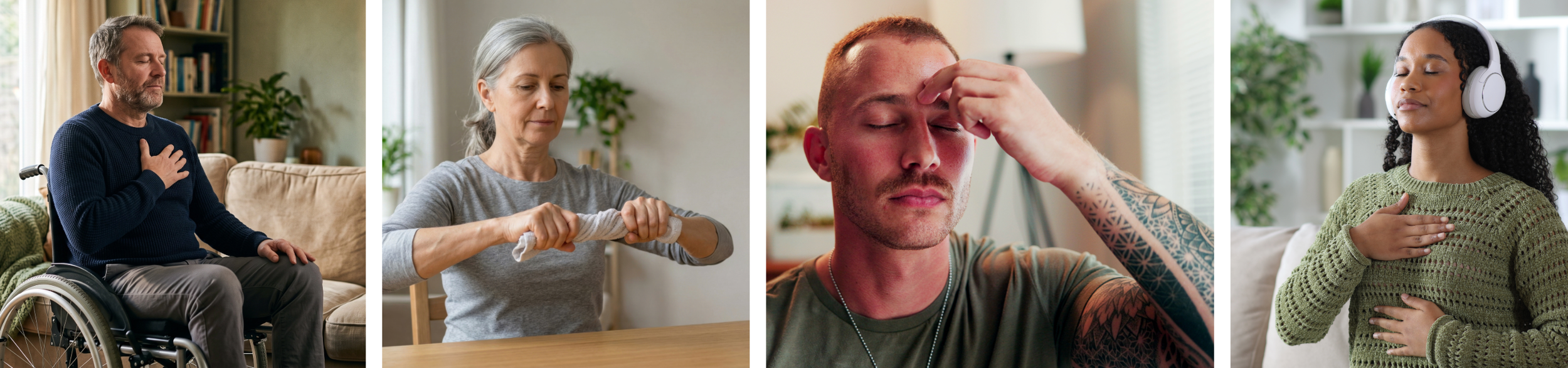
Hold a towel with both hands, a few inches apart. Inhale deeply, then tense your hands, arms and abdominal muscles while twisting the towel in opposite directions as hard as you can. Release the twist and exhale forcefully.
3 Gorilla Tapping
Make soft fists with your hands. Alternate between firm, rhythmic tapping and gentle thumping on your chest and collarbone area, moving up and down your arms, torso and legs. Coordinate the movements with deep, intentional breaths.
~ Anxiety ~
Stuck in fight-or-flight? Your body isn’t overreacting, it’s mobilized
You might already be familiar with these tools:
Grounding: pressing your feet into the floor.
Butterfly Hug: crossing your arms over your chest and lightly tapping your upper arms alternately.
Five Senses: 5 things you can see, 4 you can touch, 3 you can hear, 2 you can smell, 1 you can taste.
Physiological Sigh: 2 sharp inhales through the nose and one slow exhale through the mouth.
We wanted to take it one step further and share 3 additional body-based ways to move through anxiety somatically and help your guide activation back down.
Three somatic techniques to release anxiety
1 Full Body Bouncing
Stand with your feet hip-width apart, arms hanging loosely, and begin a soft, gentle bounce with your knees.
Incorporate arms and shoulders by shaking out your hands, jiggling your arms, and shrugging your shoulders.
Gradually add more movement with small hops, deeper bounces, or twisting side-to-side, allowing arms to swing freely.
2 Humming
Sit comfortably with a straight back and relaxed shoulders.
Take a deep breath in through your nose, then hum a steady gentle sound as you exhale.
A lower-pitched hum (like ‘voo’ or ‘om’) can be especially calming.
Aim for a pitch low enough to create a gentle rumble that vibrates through your chest and abdomen
3 Self-Soothing Touch
Sit comfortably with your back against the wall, or lie down.
Choose a holding position below and apply light, steady pressure.
Heart and Belly Hold: Place one hand on your heart and the other on your lower abdomen.
Head Support: Place one hand on your forehead and the other on the back of your head.
Self-Hug: Place your left hand under your right armpit and your right hand on your upper left arm.
Wait for small signs of release (such as warmth, a sigh, or a deep breath). If emotions feel too intense, gently shift your focus to a safe, neutral part of your body.
⚠️ Practice with caution: work within your window of tolerance, avoid overwhelming intensity, and pause if activation escalates too quickly to avoid re-traumatization.

Music has a unique ability to influence both the mind and body
Whether it's a favourite song that brings comfort or gentle instrumental music that encourages stillness, intentionally incorporating music into our self-care routines can be a simple yet powerful way to create moments of calm and support overall well-being.
According to neuroscience, the song Weightless by Marconi Union has shown to reduce anxiety by up to 65%
During a study run by Dr. David Lewis-Hodgson of Mindlab International, participants were asked to complete stress-inducing puzzles as quickly as possible, while researchers measured brain activity and physiological states. The song, Weightless, was found to lower participants’ overall anxiety by 65% along with their physiological resting rates by 35%.
The song was created collaboratively with sound therapists. Its goal was to reduce listeners’ heart rate, blood pressure and cortisol through careful creation of the perfect harmonies, rhythms and melodies. The track utilizes a continuous rhythm of 60 beats per minute and eventually slows down to 50 BPM.
The next time you’re looking for a way to relax, breathe and refocus, consider plugging in your headphones to this song. Whether you’re coping with the stress of school, work, or in your personal life, we recognize the impact that music can have on restoring one’s well-being.
🎵 Are you curious? Take a listen here.
Meeting you where you are, wherever you are, with virtual therapy in Ontario
At Holly Blue Psychotherapy Group, we take a collaborative approach to online therapy for individuals, relationships and families. If you are looking to dive deeper into feelings of anger, anxiety and stress, we are here to help. Click the link below to book a free 15 minute consultation.